Introduction
The Convention of 5 October 1961 Abolishing the Requirement of Legalization for Foreign Public Documents (commonly referred to as the Apostille Convention) is a landmark multilateral treaty that simplifies the use of public (official) documents issued in one country in another. It substitutes one standard certificate, the apostille, for the older, multi-step legalisation process. This guide draws directly from primary sources of the Hague Conference on Private International Law (HCCH) and the U.S. Department of State.
1. Historical Timeline
| Date | Milestone |
|---|---|
| 1959 | HCCH begins drafting a convention to simplify foreign document authentication |
| 5 October 1961 | The Apostille Convention was concluded at The Hague |
| 24 January 1965 | The Convention enters into force |
| 15 October 1981 | The United States begins issuing apostilles under the Convention |
| 2013 | HCCH publishes the Apostille Handbook for practical guidance |
| Today | More than 120 states participate, many with electronic apostilles (e-Apostilles) |
2. Scope of the Convention
Covered Public Documents
According to Article 1, the Convention covers:
- Documents from authorities or officials connected with courts or tribunals, including public prosecutors
- Administrative documents
- Notarial acts
- Official certificates placed on private documents, such as certificates of registration or notarial authentication of signatures
Common examples include birth, marriage, and death certificates, court judgments, notarial powers of attorney, and educational diplomas.
Excluded Documents
The Convention does not apply to:
- Documents executed by diplomatic or consular agents
- Administrative documents dealing directly with commercial or customs operations
These categories were excluded to avoid overlap with existing authentication systems.
Mutual Recognition and Uniformity
Each Contracting State must accept documents from another Contracting State that bear a valid apostille without requiring further legalisation. The apostille form is standardized and ensures recognition among all members.
3. The Apostille Certificate
Standard Format
The apostille is a square certificate at least nine centimeters per side and titled “APOSTILLE (Convention de La Haye du 5 octobre 1961).” It contains ten numbered fields specifying:
- The issuing country
- The name and position of the signatory
- The date and place of certification
- The issuing authority’s details, signature, and seal
Verification
The issuing authority must keep a register or index of apostilles, enabling verification of authenticity. Once a valid apostille is attached, no further certification or consular legalisation is needed in another Contracting State.
4. Implementation and U.S. Context
Contracting States
To check whether a country is a party to the Convention, consult the official HCCH status table at https://www.hcch.net/en/instruments/conventions/specialised-sections/apostille.
Competent Authorities
Each Contracting State designates one or more competent authorities to issue apostilles.
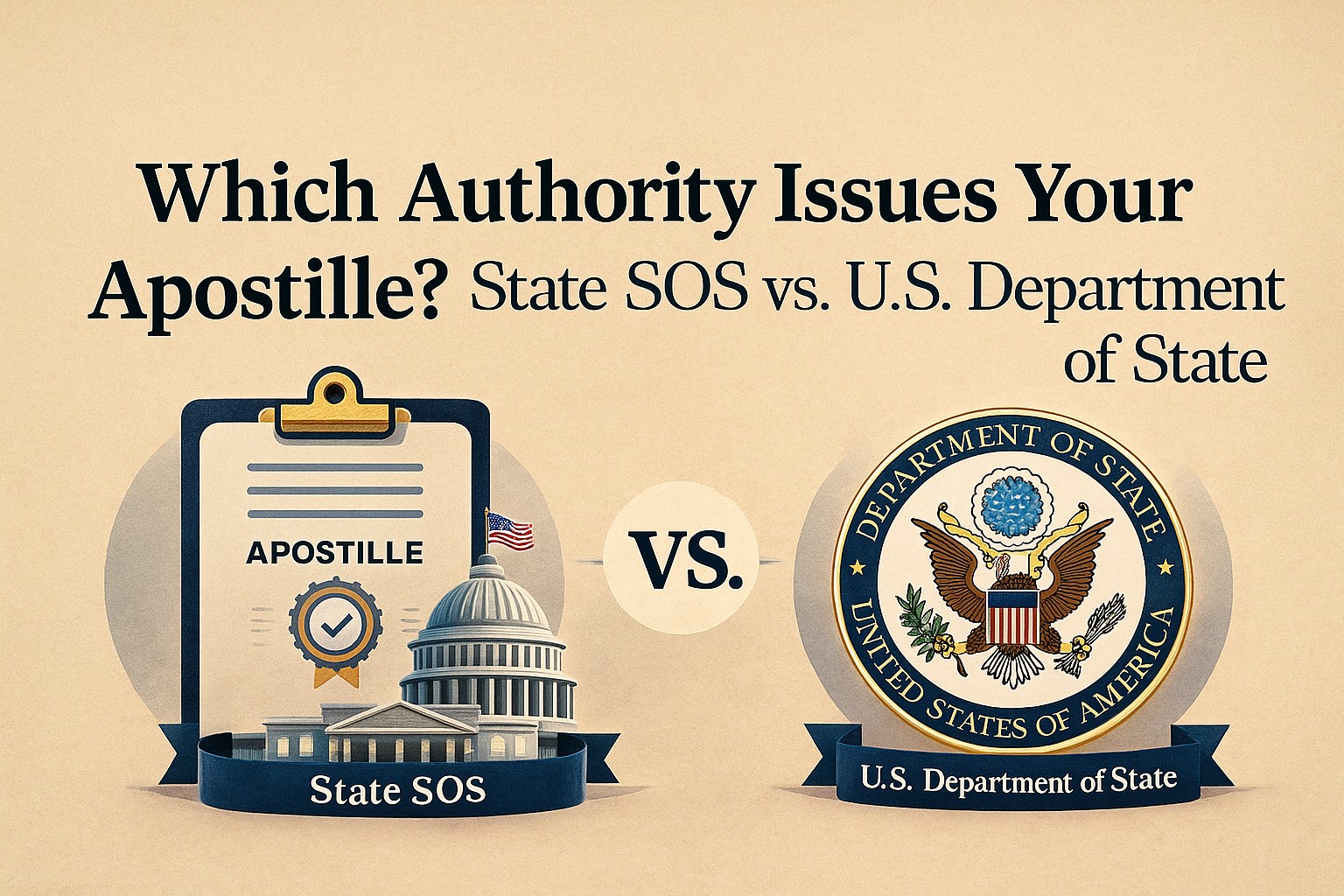
- In the United States, the Department of State’s Office of Authentications issues apostilles for federal documents.
- Each state’s Secretary of State issues apostilles for state-level documents, such as birth certificates or notarial acts.
U.S. Apostille Process
- Federal documents require an apostille from the U.S. Department of State.
- State-issued documents require an apostille from the appropriate state authority.
- If the destination country is not a party to the Convention, the document must be authenticated through full legalisation instead.
The apostille confirms only the authenticity of the signature, seal, or stamp, not the document’s content.
5. Glossary
- Apostille: The certificate issued under the Convention authenticating a public document for use in another Contracting State.
- Legalisation: The multi-step certification chain is no longer required for international use of public documents.
- Contracting State: A country that has ratified or acceded to the Convention and for which it is in force.
- Public Document: A document issued by a state authority, court, notary, or administrative office as described in Article 1.
- Competent Authority: The office authorized by each state to issue apostilles.
- State of Origin: The country where the document was issued.
- State of Destination: The country where the document will be used.
- E-Apostille: The electronic version of an apostille under the HCCH e-APP program.
6. Frequently Asked Questions
- What if the destination country is not a party to the Convention?
Then a full legalisation process is required instead of an apostille. - Does an apostille confirm the truth of the document’s contents?
No. It only verifies the authenticity of the signature, seal, or stamp. - Where can I confirm whether a country accepts apostilles?
The HCCH Apostille Convention status table provides the current list of Contracting States: HCCH Apostille Status Table. - What is the difference between an apostille and legalisation?
An apostille is a simplified one-step authentication used between Convention members. Legalisation is the older, multi-step process required for non-member countries. - Who issues apostilles in the United States?
The U.S. Department of State for federal documents and each state’s Secretary of State for state-issued documents. - Are electronic apostilles valid?
Yes. Many countries issue e-apostilles and maintain online verification registers through the HCCH e-APP program.
7. Why This Matters
Understanding the Apostille Convention allows individuals and organizations to use official documents abroad efficiently and securely. It ensures global recognition, reduces costs, and eliminates bureaucratic delays. For U.S. users, knowing whether to approach a state or federal authority ensures a smooth authentication process.
8. Key References
- Full Convention text: HCCH Apostille Convention 1961
- Apostille Handbook (HCCH Practical Handbook): HCCH Apostille Handbook PDF
- HCCH Apostille Status Table: HCCH Status Table
U.S. Department of State Apostille Requirements: travel.state.gov Apostille Guide