The Definitive Guide for U.S. Documents Destined for Hague Convention Countries
(By the American Apostille Association Resources Hub)
What Is an Apostille and When Is It Required?
An apostille is a certificate issued under the Hague Convention of 5 October 1961 (Abolishing the Requirement of Legalisation for Foreign Public Documents). It authenticates the origin of a public document, such as a birth certificate, notarial act, or court order, so it can be legally recognized in another member country.
According to the Hague Conference on Private International Law (HCCH) and the U.S. Department of State, the apostille replaces the older, more complex “chain legalization” process between Convention countries.
Hague vs. Non-Hague Countries
If your destination country is a party to the Hague Apostille Convention, your document will require an apostille, not a full embassy or consular legalization.
If the destination country is not a party, you must follow the full authentication and legalization process, which involves both the U.S. Department of State and the embassy or consulate of the destination country.
You can confirm a country’s status directly from the HCCH Apostille Status Table at www.hcch.net.
Preparing Your Document: Originals, Certified Copies, and Notarized Copies
Before applying for an apostille, make sure your document is suitable for authentication.
A document must bear the original signature and seal of a recognized U.S. public official, such as a notary public, court clerk, registrar, or federal officer.
Understanding the Types of Documents
Original Document:
The first issue from the public authority, such as a state birth certificate or court judgment, bearing the original embossed or ink seal.
Certified Copy:
A copy issued and certified by the same authority that produced the original. For example, the California Department of Public Health issues certified copies of vital records that are valid for use in obtaining apostilles.
Notarized Copy:
A copy authenticated by a commissioned notary public. Some states require notarization for personal documents, such as diplomas or affidavits, before the apostille stage.
Make sure certifications are recent. Many states reject documents older than six to twelve months.
Understanding Jurisdiction: County, State, and Federal Routing
Knowing where to send your document is essential to prevent delays.
Each level of government, county, state, or federal, has its own competent authority for issuing an apostille.
County and Local Certifications
In some states, certain documents require an additional county clerk certification before the state will issue an apostille.
For example, in New York, documents notarized by a New York notary must first be certified by the county clerk before submission to the New York Department of State.
State Apostilles
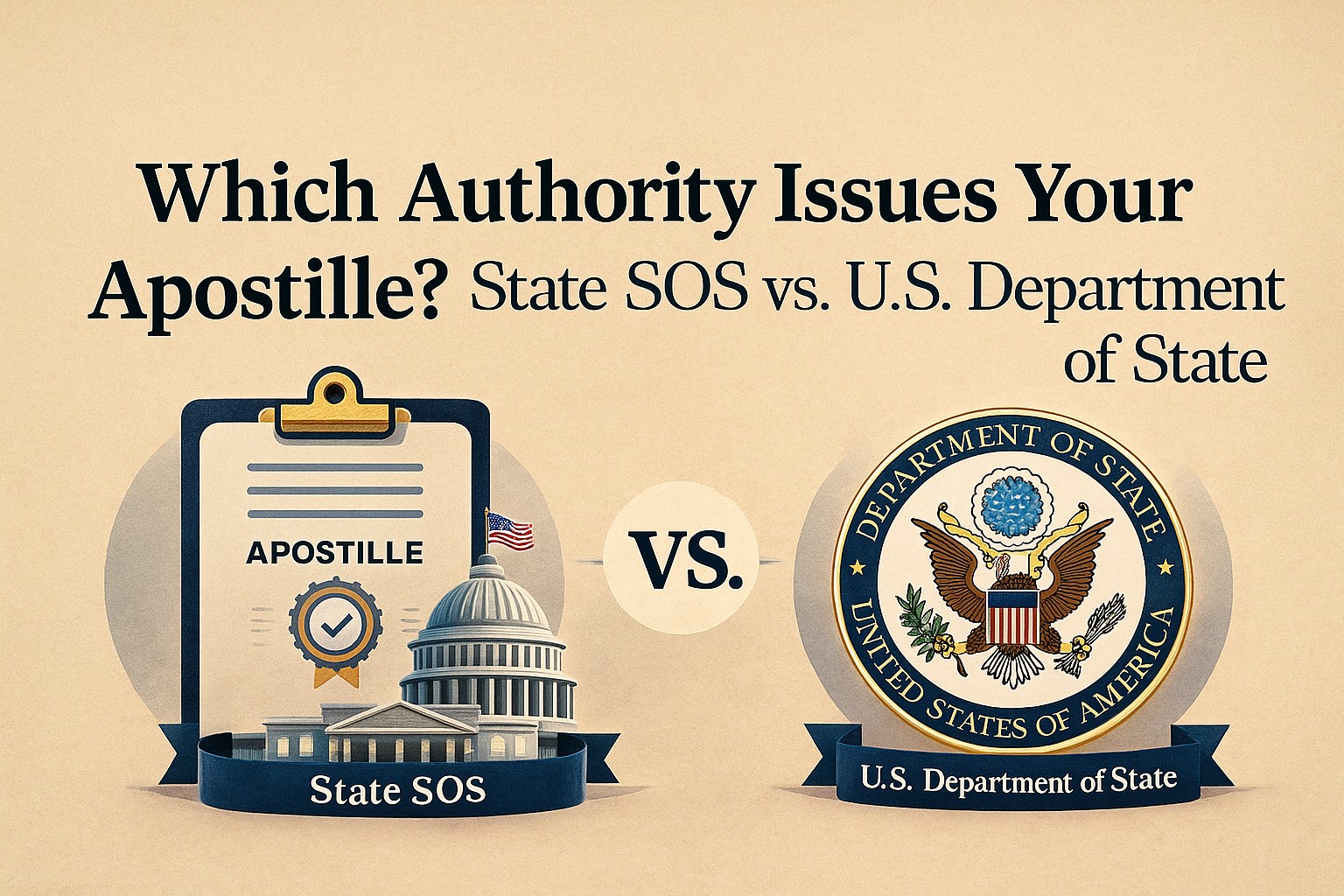
State-issued documents, such as vital records, state court judgments, or notarized papers, are apostilled by the Secretary of State or equivalent office.
Examples:
- California Secretary of State: $20 per apostille, available by mail or in person.
- Washington Secretary of State: $15 per document, with expedited service options and same-day walk-ins.
Federal Apostilles
If your document is issued by a federal agency, such as the FBI or U.S. Patent and Trademark Office, the competent authority is the U.S. Department of State Office of Authentications.
You must complete Form DS-4194, include payment of $20 per document, and mail your request to the Office in Sterling, Virginia.
Checking Your Destination Country’s Hague Status
Before applying, verify whether your destination country recognizes apostilles.
You can confirm this through the HCCH Apostille Status Table at https://www.hcch.net/en/instruments/conventions/status-table/?cid=41.
If your country is listed, apostilles apply. If not, your document will require consular legalization through the foreign embassy or consulate.
Always confirm that the country has joined the Convention and that the Convention is in force between that country and the United States.
Submitting Your Apostille Request
Once you have identified the correct authority, determine how to submit your document: by mail, in person, or through a courier service.
Mailing
All state and federal offices accept documents by mail. Include:
- The original or certified document
- Completed application form
- Correct payment (check or money order)
- A self-addressed, pre-paid return envelope
The U.S. Department of State requires this envelope for returning your documents.
In-Person Counter Service
Many Secretaries of State allow in-person requests. Washington State offers same-day apostilles for an expedited fee, while California processes in-person requests in Sacramento and Los Angeles with shorter turnaround times.
Courier or Expedite Service
If you need your apostille urgently, consider using a licensed courier or a reputable apostille service provider. Always verify that your documents are handled securely and that the provider is reputable and trustworthy.
Fees, Processing Times, and Rush Options
Processing times and costs vary by jurisdiction and the type of document.
Examples of State Fees and Times
- California Secretary of State: $20 per apostille, 3–5 business days by mail, same-day for walk-ins.
- Washington Secretary of State: $15 per document; standard processing 7–10 business days; expedited service available for an additional $100 per 10 documents.
Federal Apostilles
The U.S. Department of State charges $20 per document. Mail-in processing typically takes several weeks, depending on demand.
Before submitting, confirm the latest fees and timelines on your state’s Secretary of State website or at travel.state.gov.
Avoiding Common Rejections
Careful preparation can prevent unnecessary delays or rejections.
Frequent Reasons for Rejection
- Mismatched Names: Ensure all names match exactly across the document, notarial certificate, and application.
- Missing or Expired Seals: Verify that all signatures and seals are original and valid.
- Stale certifications: Many states will not apostille documents older than six to twelve months.
- Improper Notarization: Ensure notarial wording, date, and commission information are complete and correct.
- Translation Errors: If the destination country requires translation, use a professional translator and have the translation notarized.
Verifying Your Apostille
After receiving your apostille, confirm its authenticity.
Many U.S. states now provide online verification through QR codes or apostille registers.
For example, New York allows verification of apostilles issued after April 9, 2013, at dos.ny.gov/apostille-certificate-authentication.
Keep the apostille and the original document securely attached. Together, they form the complete legal instrument for use abroad.
What Your Final Packet Should Include
- The original or certified public document
- The attached apostille certificate
- Any notarized translations required by the destination country
- Copies of your application and payment receipt
- A tracking number or courier record for return shipment
This is the full packet you will submit to the receiving institution or authority abroad.
Quick Apostille Checklist
- Confirm the destination country is a Hague member.
- Identify whether your document is state or federal.
- Verify original, certified, or notarized status.
- Obtain county certification if required.
- Complete the correct form and payment.
- Include a pre-paid return envelope.
- Check seals, names, and notarial details.
- Submit via mail, in-person, or courier.
- Verify the apostille once received.
Simplified Apostille Flow Diagram
1. Determine destination country → Is it a Hague member?
├── Yes → Continue to apostille
└── No → Follow consular legalization route
2. Identify document type
├── State/Local → State Secretary of State
└── Federal → U.S. Department of State
3. Prepare documents
├── Original / Certified copy / Notarized
├── Check seals and translations
4. Submit documents
├── Choose mail / in-person / courier
├── Include payment and return envelope
5. Receive apostille → Verify authenticity → Send abroad
Frequently Asked Questions
- What documents can receive an apostille?
Birth, marriage, death certificates, diplomas, notarized affidavits, adoption papers, and court orders, provided they are issued or notarized in the United States.
- Can I apostille a photocopy of my diploma?
Only if the copy has been properly notarized. Some states require the notary to certify the copy as a “true copy.”
- How do I know if my document needs county certification?
Check your state’s rules. For example, New York requires county pre-certification, while California does not.
- What happens if my apostille is rejected overseas?
The receiving country may request re-issuance or translation. Always confirm requirements with your foreign recipient before submission.
- How long is an apostille valid?
An apostille does not expire, but if the underlying document or notary commission has expired, it may not be accepted abroad.
- Can I verify my apostille online?
Yes. Most states offer verification tools. New York and Texas, for example, both provide online verification through their Secretary of State websites.
- How can I speed up the process?
Use in-person or courier service, prepare all documents correctly, and check whether your state offers expedited options.
Non-Legal Advice Disclaimer
This article is provided by the American Apostille Association for educational purposes only and does not constitute legal advice. Always confirm the latest requirements with your state’s Secretary of State or the U.S. Department of State Office of Authentications before submitting your documents.